calamity
                                                             1

It is an understatement to call the earthquake in Chile a 
tragic event; it is nothing short of a complete calamity.


an event causing great and o:en sudden 
damage or distress;
disaster (n.)
servile
                                                                      2
Immediately a:er calami>es, as countries suffer from the shocks of 
inadequate resources, they are more likely to succumb to servility 
as other countries come to their aid.


excessive willingness to please or
serve others;
overly submissive (adj.)
assiduous
                                                          3
“Beyonce dances very assiduously in the ‘bootylicious’ 
video” (wiki.answers.com).


showing great care and perseverance;
diligent, persistent, hard-working (adj.)
benign
                                                             4
The stranger was far less malignant than he appeared, and 
turned out to be rather benign.


gentle, harmless (adj.)
temerity
                                                                    5
With temerity, she swaggered up to the man on the bench, 
whispered in his ear, “Could you please stop staring at me,” and 
walked off.


excessive confidence or boldness;
audacity, recklessness, fearlessness
(n.)
sagacious
                                                                  6
A lack of beauty and a shortage of sagacious mentors oppressed 
Pecola in The Bluest Eye.


showing good judgment;
wise, shrewd (adj.)
contemptuous
                                                                        7
Our illness is treated with contempt; we are made to feel guilty for 
inconveniencing others with our sickness.


showing a lack of respect;
scornful, disdainful (adj.)
abhor
                                                                   8
Being despised by the masses makes it difficult not to succumb to 
self‐abhorrence; in Pecola’s case, it was nearly impossible.


regard with disgust and hatred;
loathe, detest (v.)
bemuse
                                                                   9
I try to understand the plot, but each new page bemuses me more 
than the last.


to puzzle; confuse; bewilder (v.)
embittered
                                                            10
Pecola could have been embittered by her fatherʼs
seduction--this would be expected--but she only longed to
feel beautiful and desired.


resentful; scornful (adj.)
surreptitiously
                                                            11

Like a child sneaking out of the house, he left the hotel
surreptitiously, knowing what he had done was wrong.


doing something secretly because it
would be not be approved of (adv.)
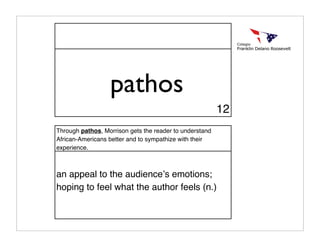
pathos
                                                         12
Through pathos, Morrison gets the reader to understand
African-Americans better and to sympathize with their
experience.


an appeal to the audienceʼs emotions;
hoping to feel what the author feels (n.)
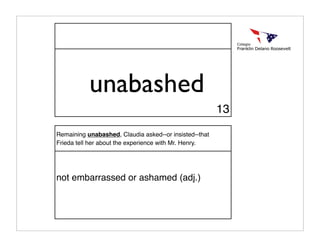
unabashed
                                                        13

Remaining unabashed, Claudia asked--or insisted--that
Frieda tell her about the experience with Mr. Henry.


not embarrassed or ashamed (adj.)
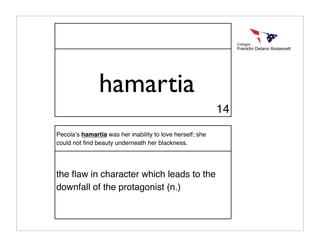
hamartia
                                                           14

Pecolaʼs hamartia was her inability to love herself; she
could not find beauty underneath her blackness.


the flaw in character which leads to the
downfall of the protagonist (n.)
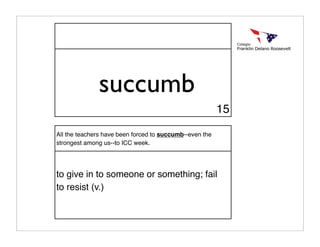
succumb
                                                         15

All the teachers have been forced to succumb--even the
strongest among us--to ICC week.


to give in to someone or something; fail
to resist (v.)
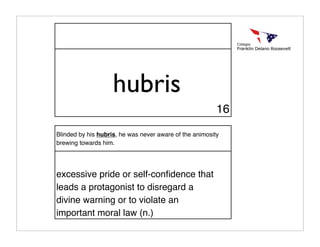
hubris
                                                         16

Blinded by his hubris, he was never aware of the animosity
brewing towards him.


excessive pride or self-confidence that
leads a protagonist to disregard a
divine warning or to violate an
important moral law (n.)
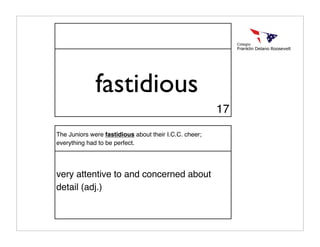
fastidious
                                                        17

The Juniors were fastidious about their I.C.C. cheer;
everything had to be perfect.


very attentive to and concerned about
detail (adj.)
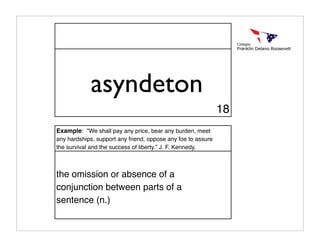
asyndeton
                                                              18
Example: “We shall pay any price, bear any burden, meet
any hardships, support any friend, oppose any foe to assure
the survival and the success of liberty.” J. F. Kennedy,
Inaugural


the omission or absence of a
conjunction between parts of a
sentence (n.)
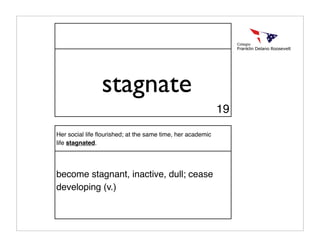
stagnate
                                                            19

Her social life flourished; at the same time, her academic
life stagnated.


become stagnant, inactive, dull; cease
developing (v.)
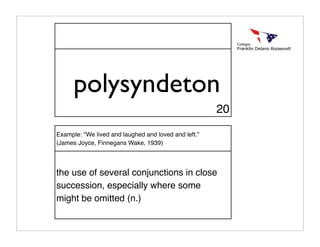
polysyndeton
                                                      20

Example: "We lived and laughed and loved and left."
(James Joyce, Finnegans Wake, 1939)


the use of several conjunctions in close
succession, especially where some
might be omitted (n.)
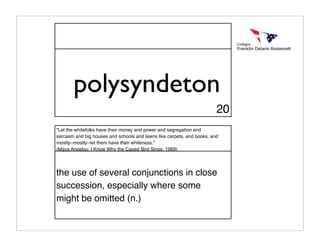
polysyndeton
                                                                        20
"Let the whitefolks have their money and power and segregation and
sarcasm and big houses and schools and lawns like carpets, and books, and
mostly--mostly--let them have their whiteness."
(Maya Angelou, I Know Why the Caged Bird Sings, 1969)


the use of several conjunctions in close
succession, especially where some
might be omitted (n.)
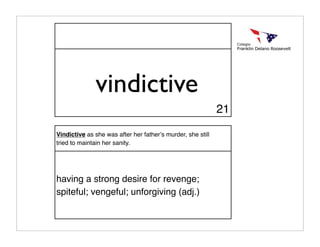
vindictive
                                                             21

Vindictive as she was after her fatherʼs murder, she still
tried to maintain her sanity.


having a strong desire for revenge;
spiteful; vengeful; unforgiving (adj.)
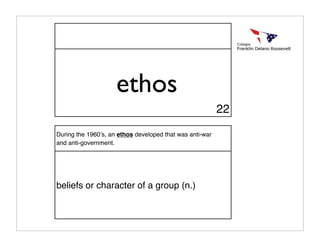
ethos
                                                          22

During the 1960ʼs, an ethos developed that was anti-war
and anti-government.


beliefs or character of a group (n.)
catharsis
                                                           23

Writing--whether itʼs fiction or non-fiction--can be a
cathartic experience, and a great way to relieve stress.


cleansing or purging of the emotions
(n.)

Sat vocabulary

  • 1.
    calamity 1 It is an understatement to call the earthquake in Chile a  tragic event; it is nothing short of a complete calamity. an event causing great and o:en sudden  damage or distress; disaster (n.)
  • 2.
    servile 2 Immediately a:er calami>es, as countries suffer from the shocks of  inadequate resources, they are more likely to succumb to servility  as other countries come to their aid. excessive willingness to please or serve others; overly submissive (adj.)
  • 3.
    assiduous 3 “Beyonce dances very assiduously in the ‘bootylicious’  video” (wiki.answers.com). showing great care and perseverance; diligent, persistent, hard-working (adj.)
  • 4.
    benign 4 The stranger was far less malignant than he appeared, and  turned out to be rather benign. gentle, harmless (adj.)
  • 5.
    temerity 5 With temerity, she swaggered up to the man on the bench,  whispered in his ear, “Could you please stop staring at me,” and  walked off. excessive confidence or boldness; audacity, recklessness, fearlessness (n.)
  • 6.
    sagacious 6 A lack of beauty and a shortage of sagacious mentors oppressed  Pecola in The Bluest Eye. showing good judgment; wise, shrewd (adj.)
  • 7.
    contemptuous 7 Our illness is treated with contempt; we are made to feel guilty for  inconveniencing others with our sickness. showing a lack of respect; scornful, disdainful (adj.)
  • 8.
    abhor 8 Being despised by the masses makes it difficult not to succumb to  self‐abhorrence; in Pecola’s case, it was nearly impossible. regard with disgust and hatred; loathe, detest (v.)
  • 9.
    bemuse 9 I try to understand the plot, but each new page bemuses me more  than the last. to puzzle; confuse; bewilder (v.)
  • 10.
    embittered 10 Pecola could have been embittered by her fatherʼs seduction--this would be expected--but she only longed to feel beautiful and desired. resentful; scornful (adj.)
  • 11.
    surreptitiously 11 Like a child sneaking out of the house, he left the hotel surreptitiously, knowing what he had done was wrong. doing something secretly because it would be not be approved of (adv.)
  • 12.
    pathos 12 Through pathos, Morrison gets the reader to understand African-Americans better and to sympathize with their experience. an appeal to the audienceʼs emotions; hoping to feel what the author feels (n.)
  • 13.
    unabashed 13 Remaining unabashed, Claudia asked--or insisted--that Frieda tell her about the experience with Mr. Henry. not embarrassed or ashamed (adj.)
  • 14.
    hamartia 14 Pecolaʼs hamartia was her inability to love herself; she could not find beauty underneath her blackness. the flaw in character which leads to the downfall of the protagonist (n.)
  • 15.
    succumb 15 All the teachers have been forced to succumb--even the strongest among us--to ICC week. to give in to someone or something; fail to resist (v.)
  • 16.
    hubris 16 Blinded by his hubris, he was never aware of the animosity brewing towards him. excessive pride or self-confidence that leads a protagonist to disregard a divine warning or to violate an important moral law (n.)
  • 17.
    fastidious 17 The Juniors were fastidious about their I.C.C. cheer; everything had to be perfect. very attentive to and concerned about detail (adj.)
  • 18.
    asyndeton 18 Example: “We shall pay any price, bear any burden, meet any hardships, support any friend, oppose any foe to assure the survival and the success of liberty.” J. F. Kennedy, Inaugural the omission or absence of a conjunction between parts of a sentence (n.)
  • 19.
    stagnate 19 Her social life flourished; at the same time, her academic life stagnated. become stagnant, inactive, dull; cease developing (v.)
  • 20.
    polysyndeton 20 Example: "We lived and laughed and loved and left." (James Joyce, Finnegans Wake, 1939) the use of several conjunctions in close succession, especially where some might be omitted (n.)
  • 21.
    polysyndeton 20 "Let the whitefolks have their money and power and segregation and sarcasm and big houses and schools and lawns like carpets, and books, and mostly--mostly--let them have their whiteness." (Maya Angelou, I Know Why the Caged Bird Sings, 1969) the use of several conjunctions in close succession, especially where some might be omitted (n.)
  • 22.
    vindictive 21 Vindictive as she was after her fatherʼs murder, she still tried to maintain her sanity. having a strong desire for revenge; spiteful; vengeful; unforgiving (adj.)
  • 23.
    ethos 22 During the 1960ʼs, an ethos developed that was anti-war and anti-government. beliefs or character of a group (n.)
  • 24.
    catharsis 23 Writing--whether itʼs fiction or non-fiction--can be a cathartic experience, and a great way to relieve stress. cleansing or purging of the emotions (n.)